|
|
|
|
There are several independent collimator manufacturers. There is also a good web site on collimator design which provides an on-line calculation of collimator characteristics from specifications provided to the program.
It is possible to carry out a simple test of a collimator's suitablility for Kr81m. All you need is a simple resolution type phantom eg a Williams phantom, The phantom should be empty (ie no water !) and the output of the Kr81m generator is connected to one of the filing holes of the phantom. There is usually a second hole designed for eliminating air bubbles and another tube fitted to this will take Kr81m gas exhausted out of the phantom away from the camera. The phantom is imaged in the usual way (remember to set the camera to Kr81m energy band!) on the surface of the collimator with the air/Kr81m flow from the generator passing through the phantom. Generally a 300 - 500k image should be enough and it can be helpful to also acquire the phantom when filled with Tc99m solution for comparison (on Tc99m settings!). The image shows the effect of any septal penetration and gives an immediate answer to whether the collimator can be used.
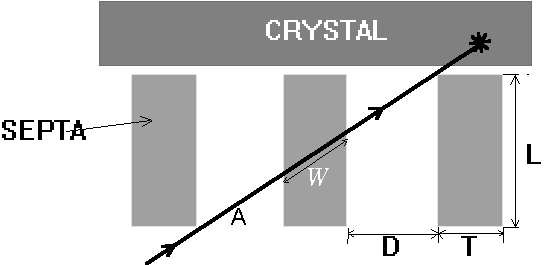
The figure below shows a schematic section through the collimator and crystal of a gamma camera.
The diagram shows a gamma ray (A) following the shortest path (W ) through the septa. The minimum length of this path is given by:
The septal attenuation along this path length can be determined from: Sept. Atten. (%) = (1 - exp-µW) * 100 where µ is the linear attenuation coefficient of the collimator material for a given gamma ray energy. Most Tc99m collimators have septal attenuation values of about 98% or greater for Tc99m (although down to about 95% was H O Anger's original concept). However experimental observations by us have lead to a value of >90% being acceptable for Kr81m for lung ventilation images.
Consider a collimator (made of lead) where T=0.025cm, L=2.25cm; D=0.16cm
For interest, the value of µ for Tc99m for lead is 28cm-1 For the same collimator at 190 keV , W is still 0.163, but µ=13cm-1; therefore Sept. Atten. at 190 keV = In this example the septal attenuation calulation of 87.9% indicates that the collimator would not be suitable for ventilation images. (NB If a medium energy collimator is necessary for the krypton images it may also be suitable for the technetium images.) | |||||||||||||||||||||||
|
Last modified: November 29, 2002 |